

Overview
Singapore’s first workplace anti-discrimination legislation, the Workplace Fairness Act (WFA), is being introduced in two parts: the First Bill and the Second Bill.
- The First Bill, passed in Parliament on 8 January 2025, outlines the protected characteristics and mandates internal grievance-handling mechanisms.
- The Second Bill, passed in Parliament on 4 November 2025, focuses on the dispute resolution framework. It is expected to take effect in 2027 and aims to promote fair treatment and strengthen workplace harmony.
The Second Bill was developed in consultation with Tripartite Partners, including the National Trades Union Congress (NTUC) and the Singapore National Employers Federation (SNEF).
What Employers Should Note: Coverage and Exemptions
The Act seeks to promote fair employment while incorporating practical exemptions.
Companies with fewer than 25 employees are exempted for the first five years after the bill’s implementation. These firms must still comply with the Tripartite Guidelines on Fair Employment Practices (TGFEP).
- Genuine occupational requirements: Employers may consider certain protected characteristics when necessary. (e.g. reasonable performance of the job, health and safety reasons, privacy, and legal or regulatory requirements.)
- Religious organisations: May employ individuals based on religion where relevant to their mission.
How the First Workplace Fairness Bill Protects Your Workforce
Protected Characteristics
At the centre of the Workplace Fairness Bill are five categories of protected characteristics:
- Age
- Nationality
- Sex, marital status, pregnancy status, caregiving responsibilities
- Race, religion and language
- Disability and neurodevelopmental disorders
These categories encompass a wide range of potential discrimination grounds and reflect on Singapore’s commitment to an inclusive work environment.
Employment Decisions Covered
The Bill’s protections extend across various stages of employment, including:
- Hiring
- Appraisals
- Training
- Promotion
- Dismissal
This comprehensive coverage ensures that employees are protected from discrimination throughout their career journey.
Enforcement Measures
To ensure compliance, the bill introduces a tiered system of enforcement measures:
Educational workshops for first-time offenders: For less severe breaches, especially by first-time offenders, the Ministry of Manpower (MOM) may issue directions to attend educational workshops. This approach aims to raise awareness and improve understanding of fair employment practices, allowing employers to correct their practices.
Administrative financial penalties for repeat offenders: For more severe or repeated violations, MOM can impose financial penalties via a contravention notice. With the District Court’s permission, the notice can be enforced against an employer just like a court judgment.
Civil penalties for serious or persistent cases: For "serious civil contraventions," the Commissioner for Workplace Fairness may, with the consent of the Public Prosecutor, apply to court for a civil penalty order.
How the Second Workplace Fairness (Dispute Resolution) Bill Reshapes Claims Process
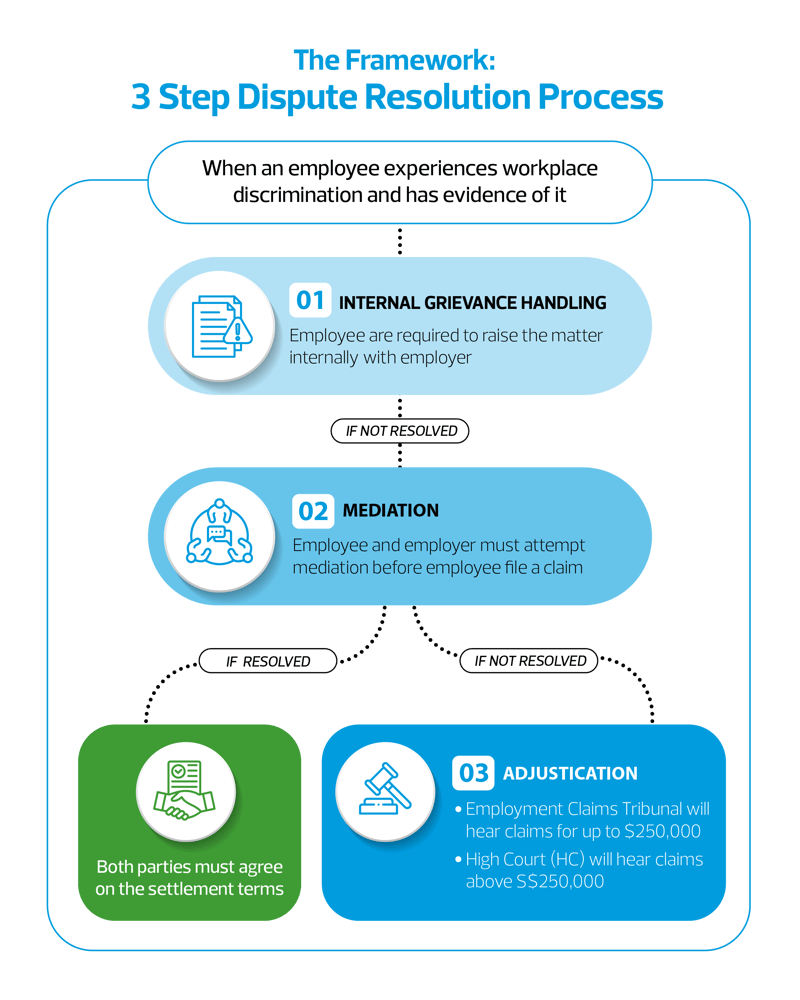
How the Employment Claims Tribunals Work: Claim Limits, Procedures and Union Roles
Claim thresholds
- Up to and including $250,000: Claims will be heard at the ECT.
- Simplified rules and streamlined procedures.
- Legal representation is not allowed.
- Union representation is permitted under specific conditions.
Union Representatives
At the ECT, legal representation is not permitted as this helps to ensure a level playing field for both workers and employers. However, workers and employers may be supported by their respective unions. Their union representatives can advise workers and employers on their rights and obligations, help parties to navigate claims and encourage amicable settlements.
Worker Union Representatives: May represent union members in unionised companies for claims up to $250,000 (inclusive) in both mediation sessions and ECT hearings.
Employers Union Representatives: May represent employer members in mediation sessions and ECT hearings for claims between S$30,000 and S$250,000 (inclusive), and only where the worker filing the claim is eligible to be represented by their worker union.
Tripartite Mediation Advisors (TMAs): Union members in non-unionised companies may seek support from TMAs, who are experienced industrial relations practitioners.
High Court: What You Need to Know
Claim thresholds
- More than $250,000: Claims will be heard by the HC.
- Strict rules of evidence and procedures will apply.
- Legal representation is allowed.
Employment Claims Tribunals & High Court 's Approach: A Judge-Led Process
Judges play an active role in managing claims:
- Judges will first assist in identifying and narrowing the main issues.
- They filter out irrelevant matters and focus on the necessary evidence.
- They take steps to progress the case efficiently by issuing procedural orders, without the need of formal applications from the parties.
This approach helps parties, especially those without legal training to navigate the claims process smoothly.
Mandatory Timelines and Procedures for Workplace Discrimination Claims
Time limits (Requests for mediation must be submitted within prescribed time limits as follows)
Pre-Employment (e.g. hiring process): Workers have 1 month from the time they are informed of the adverse employment decision. For claims involving discrimination at this stage, a maximum amount of $5,000 will be compensated.
During Employment (e.g. appraisals, training opportunities): Workers have 6 months from the time the adverse decision is made known to request mediation.
End of Employment (e.g. unfair dismissal): Workers have 1 month from the last day of employment to file for mediation.
Exceptions: Extensions may be granted in special circumstances, such as pregnancy or injury.
These timelines ensure the evidence remains timely and protect employers from outdated claims resurfacing.
Rules
- Claimants must attempt mediation before submitting a claim to the ECT or the HC.
- Mediation requests must be made within the specified time limits.
- Claims will be heard in private, and both parties are expected to consider an amicable resolution during the adjudication process.
- The ECT and HC will follow a judge-led approach, with judges taking an active role in managing the case.
- Both the ECT and HC have the authority to dismiss frivolous claims and may award costs against claimants who file such claims, on a case-by-case basis.
Mitigating the Risk of Frivolous Claims
There are several measures in place to safeguard the integrity of the claims process.
- The ECT and HC have the authority to dismiss claims that are found to be without merit, either upon request by the firm or on their own initiative.
- Individuals who file frivolous or baseless claims may face penalties, including having to pay costs, being restricted from further actions, or even facing an investigation under the Administration of Justice (Protection) Act.
- To ensure fairness, the Bill also introduces protections against exaggerated or unreasonable claims. Judges can impose costs on those who misuse the system, and the Ministry of Manpower (MOM) will provide guidelines to ensure claims remain reasonable and appropriate.
What Employers Must Do Now to Comply with the Workplace Fairness Act:
- Implement a Grievance Handling Process: Establish accessible and confidential channels for reporting grievances, with clear protections against retaliation. Employers must act now to clearly communicate their grievance handling process to employees, conduct proper investigations when incidents arise, and respond promptly to affected employees.
- Review and Revise Existing HR Policies: Conduct a thorough audit of existing HR policies to identify any biases or non-compliance risks, particularly in recruitment, performance reviews, and promotions.
- Train Employees on Fair Employment Practices: To ensure compliance, employers should train staff on protected characteristics, fair employment practices, grievance handling process, and the dispute resolution framework. In addition, employers can benchmark their organisational culture against others using TAFEP’s Fair and Progressive Employment Index.
- Support Vulnerable Groups Proactively: Introduce flexible work arrangements, safeguarding complainants’ identities, and strengthening support for older workers and caregivers.
How PayrollServe can Help?
Navigating the new requirements can be challenging. PayrollServe supports employers in developing policies which are compliant, fair, and aligned with best practices.
We provide:
- HR Health Check: Review and refresh your HR policies and practices for legal compliance
- Policy Crafting & Implementation: Develop clear, fair and workable HR policies
- HR Advisory Support: We provide advisory support on updating existing HR policies in line with employment law and best practices. In addition, we also deliver recommendations on compliance, governance and workforce matters across the HR spectrum.
Contact us to find out more about how PayrollServe can help.